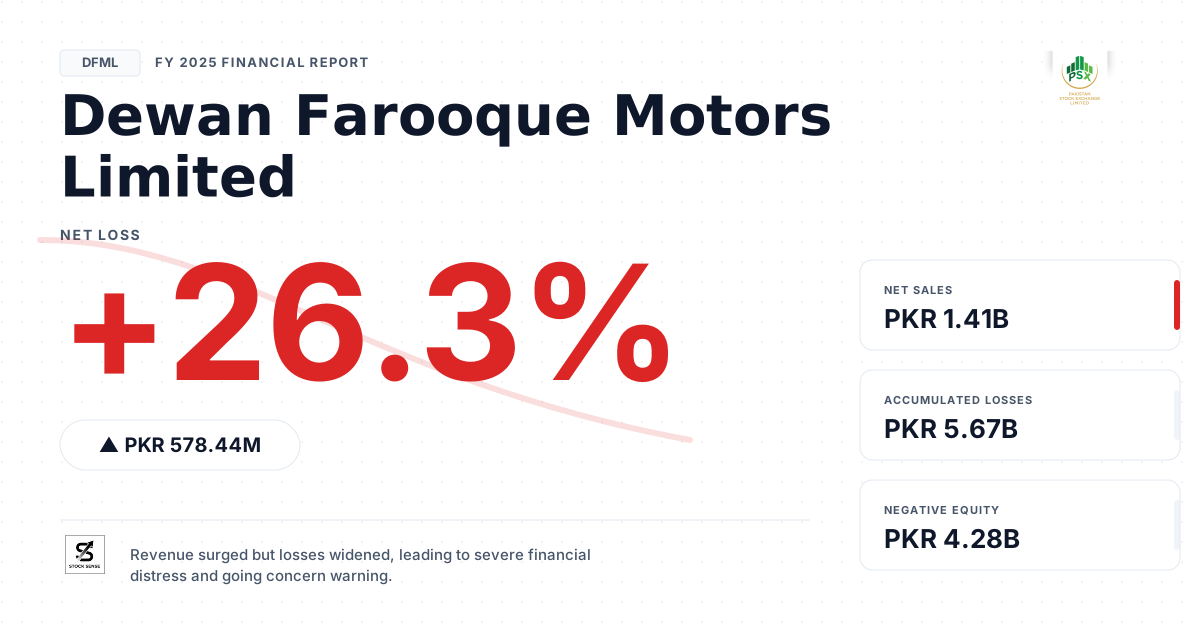
Dewan Farooque Motors Limited (DFML) has reported its financial results for the year ended June 30, 2025, revealing a dramatic increase in net sales by over 140 times to PKR 1.41 billion. However, this impressive top-line growth was unfortunately accompanied by a significant widening of the company's net loss for the year, which grew by 26.3% to PKR 578.44 million. Compounding these challenges, the auditors have issued an emphasis of matter regarding the 'going concern' assumption, and their report is qualified due to the non-provisioning of mark-up, signaling severe ongoing financial challenges for the company.
Financial Performance: A Deep Dive into the Numbers
{
  "rows": [
    [
      "Sales - Net",
      "1,405,314",
      "9,953",
      "14029%"
    ],
    [
      "Cost of sales",
      "(1,706,186)",
      "(292,833)",
      "482%"
    ],
    [
      "Gross loss",
      "(300,872)",
      "(282,880)",
      "6.36%"
    ],
    [
      "Marketing and distribution expenses",
      "(67,183)",
      "(106,693)",
      "-37.03%"
    ],
    [
      "Administration and general expenses",
      "(62,948)",
      "(38,093)",
      "65.25%"
    ],
    [
      "Operating loss",
      "(431,003)",
      "(427,666)",
      "0.78%"
    ],
    [
      "Other (loss)",
      "(129,152)",
      "(29,856)",
      "332.9%"
    ],
    [
      "Finance cost",
      "(553)",
      "(200)",
      "176.5%"
    ],
    [
      "Loss for the year",
      "(578,443)",
      "(457,847)",
      "26.34%"
    ]
  ],
  "type": "table",
  "headers": [
    "Financial Metric (PKR '000)",
    "FY 2025",
    "FY 2024",
    "Change (%)"
  ]
}
The standout figure is undoubtedly the monumental jump in net sales, from a mere PKR 9.95 million in 2024 to PKR 1.41 billion in 2025, representing a staggering 14,029% growth. This indicates a substantial increase in operational activity. However, the cost of sales also surged by 482% to PKR 1.71 billion, leading to a gross loss of PKR 300.87 million, a 6.36% increase from PKR 282.88 million last year. This suggests that while DFML is selling significantly more, its core operations remain deeply unprofitable, with costs far exceeding revenue.
Operating expenses presented a mixed picture. Marketing and distribution expenses saw a notable decrease of 37.03% from PKR 106.69 million to PKR 67.18 million, indicating some cost control efforts. Conversely, administration and general expenses rose sharply by 65.25% from PKR 38.09 million to PKR 62.95 million. Despite these shifts, the overall operating loss remained largely stable at PKR 431 million, reflecting the persistent challenge of achieving operational efficiency.
The net loss for the year deepened to PKR 578.44 million from PKR 457.85 million, a 26.34% increase. A significant contributor to this widening loss was a substantial increase in 'Other (loss),' which surged by 332.9% to PKR 129.15 million. This category, as detailed in the cash flow statement, includes a considerable loss of PKR 130.65 million from the revaluation of investments in associates, highlighting non-operational pressures on profitability. Levies also saw a dramatic increase from PKR 0.12 million to PKR 17.57 million.
Balance Sheet & Liquidity Concerns
From a balance sheet perspective, the company's financial health has further deteriorated. Accumulated losses have swelled to PKR 5.67 billion as of June 30, 2025, up from PKR 5.09 billion in the prior year. This translates to a negative equity position of PKR 4.28 billion (2024: PKR 3.70 billion), indicating that liabilities significantly outweigh assets and shareholder funds are entirely eroded.
Current liabilities have also increased significantly, particularly short-term loans from related parties, which rose by 24.76% (PKR 420 million) to PKR 2.12 billion. This continued reliance on related-party financing underscores the company's ongoing liquidity challenges and its dependence on internal group support to sustain operations.
While cash used in operations improved substantially, reducing from an outflow of PKR 941.58 million in 2024 to PKR 147.11 million in 2025, the company still ended the year with negative cash and cash equivalents of PKR 1.76 billion. This persistent negative cash position is a critical indicator of financial strain.
Strategic Signals & Auditor's Warning
As expected given the substantial losses, the company's board has not recommended any cash dividend, bonus shares, or right shares for the year. A critical point for investors is the auditors' report, which includes an 'emphasis of matter' regarding the 'going concern' assumption. Furthermore, the report is qualified specifically due to the non-provisioning of mark-up by the Company, indicating a fundamental issue with the company's ability to meet its financial obligations and continue operations in the long term without significant financial restructuring or support.
Capital expenditures incurred decreased significantly by 74.2% from PKR 353.75 million in 2024 to PKR 91.01 million in 2025. This sharp reduction suggests a slowdown in new investments in property, plant, and equipment, potentially due to capital constraints or a strategic shift.
Investor Takeaway: High Risk, Uncertain Path
DFML's latest results present a starkly mixed picture. While the extraordinary growth in sales suggests a revitalized operational effort and potential market traction, the deepening losses, persistent negative equity, and the auditor's explicit 'going concern' warning paint a stark reality of the severe financial distress the company faces. For investors, the immediate future remains highly uncertain and fraught with risk.
Key areas for investors to monitor closely include:
- Path to Profitability: Can the company leverage its sales growth to achieve gross and operating profitability in the coming quarters?
- Financial Restructuring: What steps will management take to address the accumulated losses, negative equity, and high debt burden, especially the reliance on related-party financing?
- Going Concern Resolution: How will the company address the auditor's 'going concern' emphasis and the qualification regarding non-provisioning of mark-up? This is a fundamental risk that needs clear communication and action.
- Dividend Prospects: With significant accumulated losses and negative equity, dividends are not on the horizon, reinforcing the need for a clear turnaround strategy.
DFML remains a high-risk investment, suitable only for those with a high tolerance for risk and a long-term view, contingent on a credible and executable plan to achieve sustainable profitability and financial stability. Without a clear strategy to address its fundamental financial challenges, the company's future remains precarious.