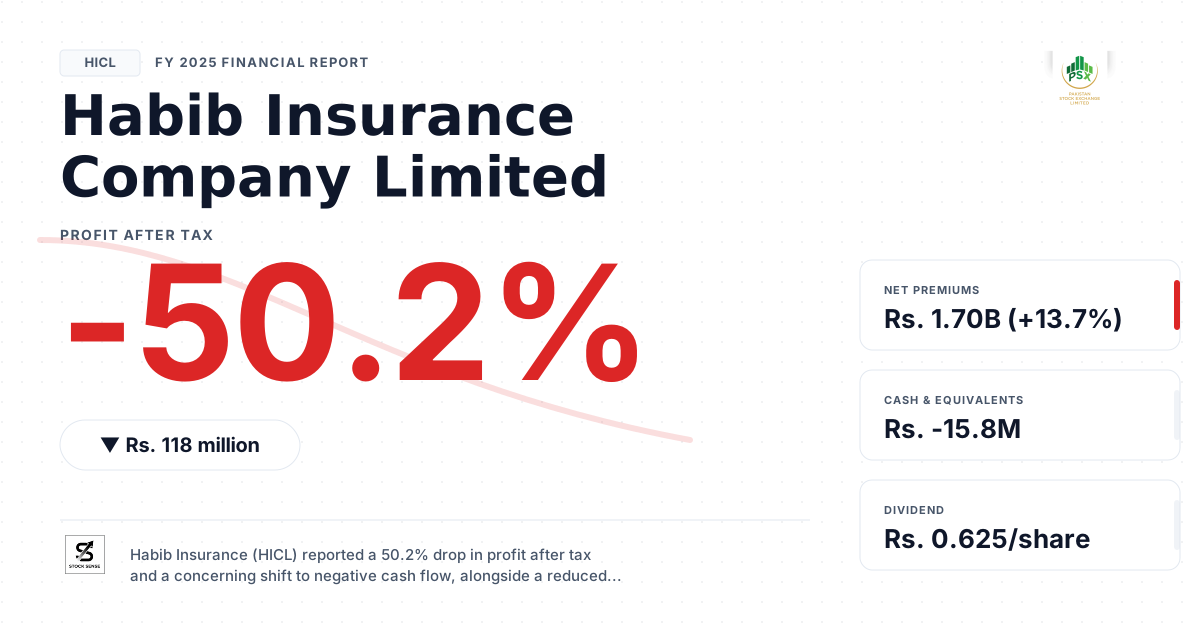
Habib Insurance Company Limited (HICL) has announced its financial results for the year ended December 31, 2025, revealing a significant 50.2% drop in profit after tax and a concerning shift to a negative cash and cash equivalents balance, as reported in its cash flow statement. Despite a healthy 13.7% increase in net insurance premiums, sharp declines in investment and other income, coupled with a 14.7% surge in net claims, significantly impacted the bottom line. The company has declared a cash dividend of 12.5% (Rs. 0.625 per share), a reduction from the Rs. 1.0 per share paid for 2024.
Financial Performance Overview
HICL's net insurance premium showed resilience, growing by a robust 13.7% to Rs. 1.70 billion (Rs. 1,697 million) in 2025 from Rs. 1.49 billion (Rs. 1,492 million) in the previous year. This indicates continued business generation and market presence in its core operations. However, this top-line growth did not translate into improved profitability.
Profit after tax plummeted by 50.2% to Rs. 118 million (Rs. 118,033 thousand) in 2025, a stark contrast to Rs. 237 million (Rs. 236,852 thousand) recorded in 2024. Consequently, Basic Earnings Per Share (EPS) also halved by 50.3% from Rs. 1.91 to Rs. 0.95. Encouragingly, the underwriting segment, while still reporting a loss, saw a 10.2% improvement, narrowing its deficit from Rs. 227 million (Rs. 226,667 thousand) to Rs. 204 million (Rs. 203,621 thousand).
A critical development is the company's liquidity. HICL ended 2025 with a negative cash and cash equivalents balance of Rs. 15.8 million (Rs. -15,858 thousand), a sharp reversal from a positive balance of Rs. 250.6 million (Rs. 250,601 thousand) in 2024. It is important to note that while the balance sheet shows a positive 'Cash and bank' balance of Rs. 42.1 million, the cash flow statement's 'Cash and cash equivalents' figure, which includes bank overdrafts, indicates a net negative position. While net cash inflows from underwriting activities improved by 10% to Rs. 657.6 million, overall net cash flows from all activities turned more negative, from an outflow of Rs. 220.8 million in 2024 to Rs. 266.5 million in 2025, signaling significant liquidity challenges.
On the balance sheet, total assets expanded by 19.8% from Rs. 6.48 billion (Rs. 6,484 million) to Rs. 7.77 billion (Rs. 7,769 million), primarily driven by increased investments in both equity and debt securities. Total equity also grew by 15.2% to Rs. 2.37 billion (Rs. 2,368 million) from Rs. 2.06 billion (Rs. 2,055 million), despite the profit decline, largely supported by significant other comprehensive income components, particularly unrealized gains on available-for-sale investments.
Key Drivers of Profit Decline
The primary factors contributing to the significant profit decline include:
- A significant 14.7% increase in net insurance claims, rising from Rs. 934 million (Rs. 934,289 thousand) to Rs. 1.07 billion (Rs. 1,071,159 thousand).
- A substantial 12.6% drop in investment income from Rs. 459 million (Rs. 459,050 thousand) to Rs. 401 million (Rs. 401,283 thousand).
- A dramatic 91.6% fall in 'Other Income' from Rs. 122 million (Rs. 122,211 thousand) in 2024 to just Rs. 10 million (Rs. 10,262 thousand) in 2025. This particular decline is a major contributor to the reduced profitability and warrants immediate scrutiny.
While the growth in net insurance premiums suggests an expanding core insurance business, profitability is being severely eroded by higher claims and a sharp reduction in non-underwriting income streams.
Management Actions & Strategic Signals
The Board has recommended a cash dividend of Rs. 0.625 per share (12.5%), which is lower than the Rs. 1.0 per share distributed for the year 2024. No bonus shares were announced. A transfer of Rs. 40 million to reserves was also approved. The decision to cut the dividend reflects the challenging earnings environment, but the negative cash and cash equivalents balance raises serious questions about the sustainability of even this reduced payout without external financing or asset liquidation.
The increase in investments on the balance sheet, while cash and cash equivalents declined, indicates a strategic deployment of funds. However, the resulting negative cash position suggests potential liquidity management issues or a mismatch between investment liquidity and operational cash needs, which could be a red flag for investors.
Investor Takeaway
For investors, HICL's 2025 results present a mixed picture. While premium growth is a positive sign for the underlying business, the halving of profits and the alarming negative cash and cash equivalents balance are significant concerns. Key areas to watch for include:
- Liquidity Management: How management plans to address the negative cash and cash equivalents balance will be paramount. This is an unusual and potentially risky situation for an insurance company, demanding immediate attention.
- Income Diversification: The sharp drop in 'Other Income' needs clarification. Investors should look for details on the nature of this income and plans for its recovery or diversification.
- Investment Strategy: Given the decline in investment income and increased deployment into investments, understanding the company's investment strategy and its impact on both returns and liquidity is crucial.
- Dividend Sustainability: While a dividend was declared, its reduction and the negative cash flow raise questions about future payouts if earnings and cash generation do not improve.
Investors should monitor HICL closely for signs of improved cash flow generation and a turnaround in non-underwriting income streams. The company's ability to navigate these financial headwinds will be key to its performance in the coming year.