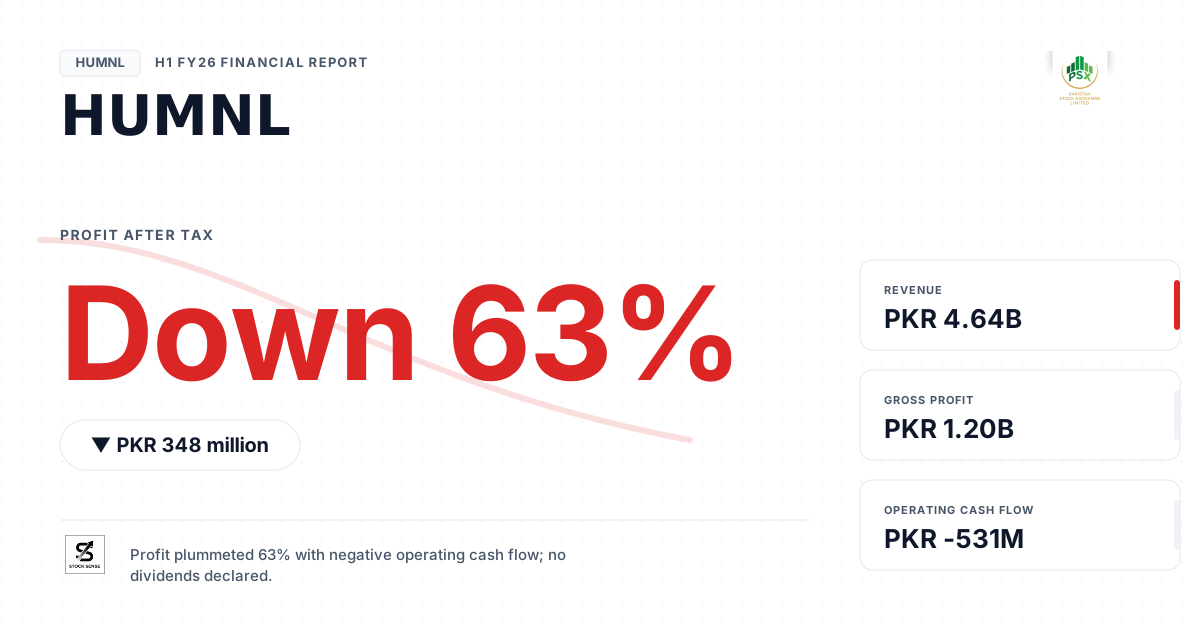
Hum Network Limited (HUMNL) has reported a challenging first half for the fiscal year ending December 31, 2025, with consolidated profit after tax plummeting by approximately 63% compared to the same period last year. This significant drop in profitability, coupled with a dramatic swing to negative operating cash flow, signals a period of operational headwinds for the media company. Disappointingly for shareholders, the Board of Directors has recommended no cash dividend, bonus shares, or right shares.
Financial Performance Overview
The consolidated revenue for the half-year stood at PKR 4.64 billion, a decline of about 8.6% from PKR 5.07 billion in the previous year. While the most recent quarter (Q2 FY26) showed a slight revenue increase to PKR 2.88 billion from PKR 2.83 billion in Q2 FY25, this marginal growth was insufficient to offset the overall half-yearly trend or improve profitability.
Profitability metrics saw a sharp deterioration. Gross profit for the half-year fell by a substantial 40% to PKR 1.20 billion from PKR 2.00 billion. This indicates significant pressure on margins, likely due to rising production costs relative to revenue. Consequently, consolidated profit after tax attributable to owners crashed to PKR 348 million (EPS of PKR 0.31) for the half-year, down from PKR 948 million (EPS of PKR 0.84) in H1 FY25. The second quarter alone was particularly weak, with profit after tax plummeting by approximately 87% to PKR 31.6 million (EPS of PKR 0.03) from PKR 235 million (EPS of PKR 0.21) in the corresponding quarter last year.
From a cash flow perspective, the company's consolidated net cash generated from operating activities swung dramatically from a positive PKR 914 million in H1 FY25 to a negative PKR 531 million in H1 FY26. This is a critical concern, as it suggests the core business is not generating sufficient cash to fund its operations. However, net cash from investing activities saw a positive turnaround, generating PKR 926 million, primarily driven by the redemption of short-term investments and profit received on bank accounts. Despite the operational cash outflow, the company ended the period with higher cash and bank balances of PKR 3.29 billion, up from PKR 2.92 billion at June 30, 2025, largely due to these investing activities.
The balance sheet shows an increase in total assets to PKR 14.72 billion from PKR 14.13 billion. Equity attributable to owners also grew to PKR 12.02 billion from PKR 11.65 billion, reflecting retained earnings. Current liabilities, particularly trade and other payables, also saw an increase, which warrants close monitoring.
Key Operational Drivers and Strategic Signals
While the condensed interim financial statements do not provide a detailed breakdown of performance by specific business segments, the significant increase in 'cost of production' (from PKR 2.70 billion to PKR 3.17 billion) points to rising operational expenditures impacting gross margins, even as 'transmission cost' saw a decrease. The substantial 'other income' of PKR 293 million for the half-year, though lower than the previous year's PKR 408 million, continues to be a notable contributor to the bottom line, helping to partially offset the core operational challenges. A decrease in 'television program costs' under current assets, from PKR 1.40 billion to PKR 1.36 billion, suggests a potential shift in content investment strategy or faster amortization of existing programs.
The declaration of NIL dividends, bonus, or right shares underscores the company's focus on conserving cash amidst the current financial performance. The shift in cash flow dynamics, with negative operating cash flow being offset by positive investing cash flow from short-term investments, suggests a strategic reallocation of capital. Additions to property and equipment, amounting to approximately PKR 100 million for the half-year, indicate continued, albeit measured, capital expenditure. The unconsolidated balance sheet also shows a new 'loan from related party' of PKR 250 million, which could be a source of liquidity or working capital support.
Investor Takeaway
For investors, HUMNL's latest results present a mixed picture. The dramatic decline in profitability and EPS, especially in the most recent quarter, is a significant concern. The negative operating cash flow is a red flag, indicating that the core business is struggling to generate cash. While the company's cash reserves remain healthy due to strategic investment liquidations, this is not a sustainable long-term solution for operational funding.
Shareholders should closely monitor the company's ability to improve its gross and operating margins, control costs, and restore positive cash flow from its core operations in the upcoming quarters. The absence of dividends will disappoint income-focused investors. The stock's future performance will heavily depend on a clear turnaround in operational efficiency and a return to sustainable profitability.