Jahangir Siddiqui & Co. Ltd. (JSCL), a prominent investment holding company, has reported a nuanced set of consolidated financial results for the year ended December 31, 2025. While total consolidated income and overall Profit After Tax (PAT) saw a decline, the company demonstrated robust strategic asset management. This led to a significant surge in cash generated from investing activities and a surprising uptick in Earnings Per Share (EPS) attributable to parent shareholders, signaling a proactive strategic pivot in a challenging economic environment.
Consolidated Financial Performance Overview
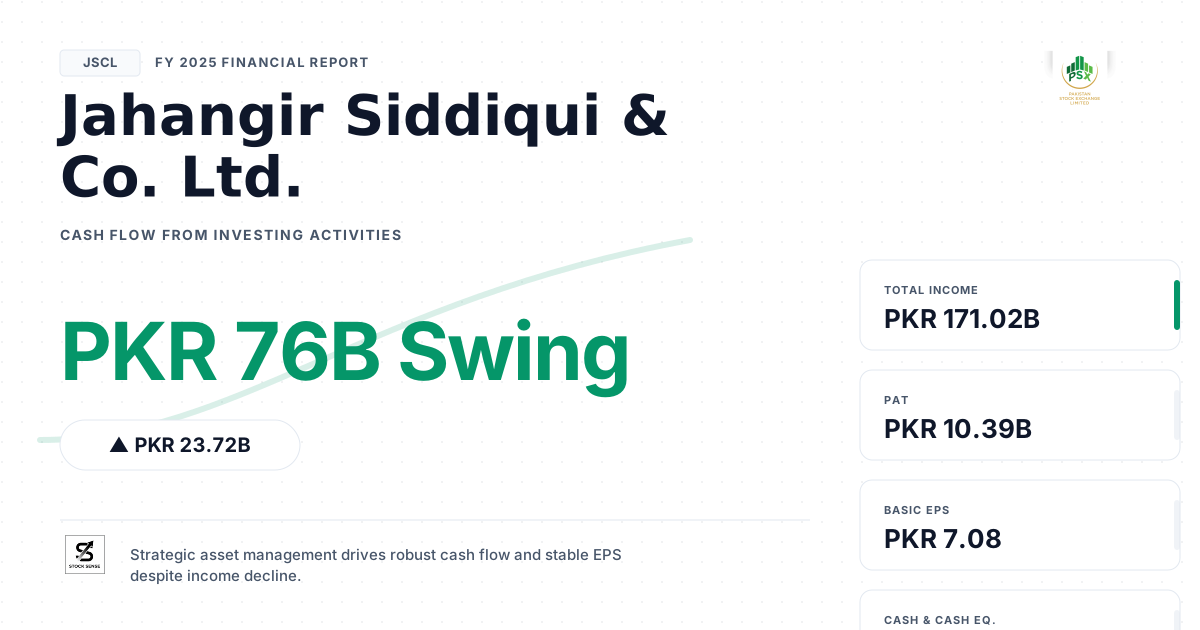
Total consolidated income for JSCL decreased notably by approximately 28.3%, falling from PKR 238.63 billion in 2024 to PKR 171.02 billion in 2025. This was primarily driven by lower returns on investments and reduced income from loans and fund placements. Consequently, the overall consolidated Profit After Tax (PAT) also saw a decline, dropping from PKR 13.14 billion to PKR 10.39 billion, a decrease of about 20.9%.
Despite the dip in overall consolidated PAT, the Basic EPS attributable to the parent company's shareholders showed a slight increase, moving from PKR 7.03 in 2024 to PKR 7.08 in 2025. This positive divergence is due to a marginal increase of 0.6% in the profit directly attributable to the equity holders of the parent, even as the total group profit declined, highlighting effective management of shareholder-level profitability.
A significant highlight from the consolidated cash flow statement is the company's liquidity management. While cash generated from operating activities saw a sharp decline of over 80%, from PKR 51.21 billion in 2024 to PKR 10.18 billion in 2025, cash flow from investing activities turned strongly positive. It swung from a usage of PKR 53.21 billion in 2024 to a generation of PKR 23.72 billion in 2025 – a remarkable positive swing of over PKR 76 billion. This was largely due to substantial net investment sales, underscoring active portfolio management. Overall, cash and cash equivalents significantly increased by approximately 32.5%, from PKR 89.57 billion to PKR 118.73 billion, bolstering the company's liquidity position.
On the consolidated balance sheet, total assets grew by 4.3% from PKR 1.378 trillion to PKR 1.437 trillion. Long-term investments also saw an increase. However, the Total Comprehensive Income (TCI) experienced a sharp decline of about 54%, falling from PKR 19.05 billion to PKR 8.77 billion. This substantial reduction was mainly due to a swing from fair value gains to losses on investments classified as Fair Value Through Other Comprehensive Income (FVOCI), reflecting market volatility impacting investment valuations.
Key Drivers & Strategic Responses
The decline in core income, particularly from 'Return on investments' and 'Income from loans, advances and fund placements', was a primary challenge. However, JSCL effectively managed key expenditures, which helped cushion the impact on overall profitability:
- Reduced Finance Costs: Finance costs decreased significantly by 44%, from PKR 147.56 billion in 2024 to PKR 82.84 billion in 2025, indicating effective debt management or a favorable interest rate environment.
- Lower Impairment Provisions: Provision for impairment dropped substantially by 72%, from PKR 8.53 billion in 2024 to PKR 2.37 billion in 2025, reflecting potentially improved asset quality or a more stable market outlook.
- Increased Share of Associate Profits: The company's share of profit from associates saw a healthy increase of over 400%, from PKR 0.49 billion in 2024 to PKR 2.55 billion in 2025, contributing positively to the bottom line.
The strong positive cash flow from investing activities was predominantly driven by net sales of investments (PKR 37.64 billion in 2025 compared to net purchases of PKR 43.41 billion in 2024), a clear indication of active portfolio management to generate liquidity and optimize capital allocation.
Management Actions & Investor Outlook
Management's focus appears to be on optimizing the balance sheet and managing liabilities. The significant reduction in finance costs and impairment provisions points to a disciplined approach to financial health. The increase in property and equipment (from PKR 33.92 billion to PKR 44.40 billion) suggests some capital expenditure, potentially for growth or operational efficiency within its diverse business segments.
The financial results announcement did not include any dividend declaration for the year ended December 31, 2025. While the consolidated cash flow statement shows 'dividends paid' (PKR 852.31 million in 2025), these likely relate to previous declarations. Investors will need to await future announcements for any new dividend policy.
Key Investor Takeaways
JSCL's latest consolidated results present a nuanced picture for investors. While core income generation faced headwinds, leading to a decline in overall group PAT, the company demonstrated resilience through strategic financial management. The significant reduction in finance costs and impairment provisions, coupled with a strong positive swing in cash from investing activities due to asset sales, highlights management's proactive approach to liquidity and balance sheet strength. The stable EPS for parent shareholders, despite a lower overall PAT, is a notable point for equity investors, indicating a protected share of earnings.
Investors should closely monitor the sustainability of investment income and the performance of its loan and fund placement segments in the coming quarters. The substantial drop in Total Comprehensive Income due to fair value losses on FVOCI investments also warrants attention as it impacts the overall wealth creation for shareholders. The company's ability to maintain cost efficiencies and generate cash from strategic asset management will be key to its performance in the evolving market landscape.