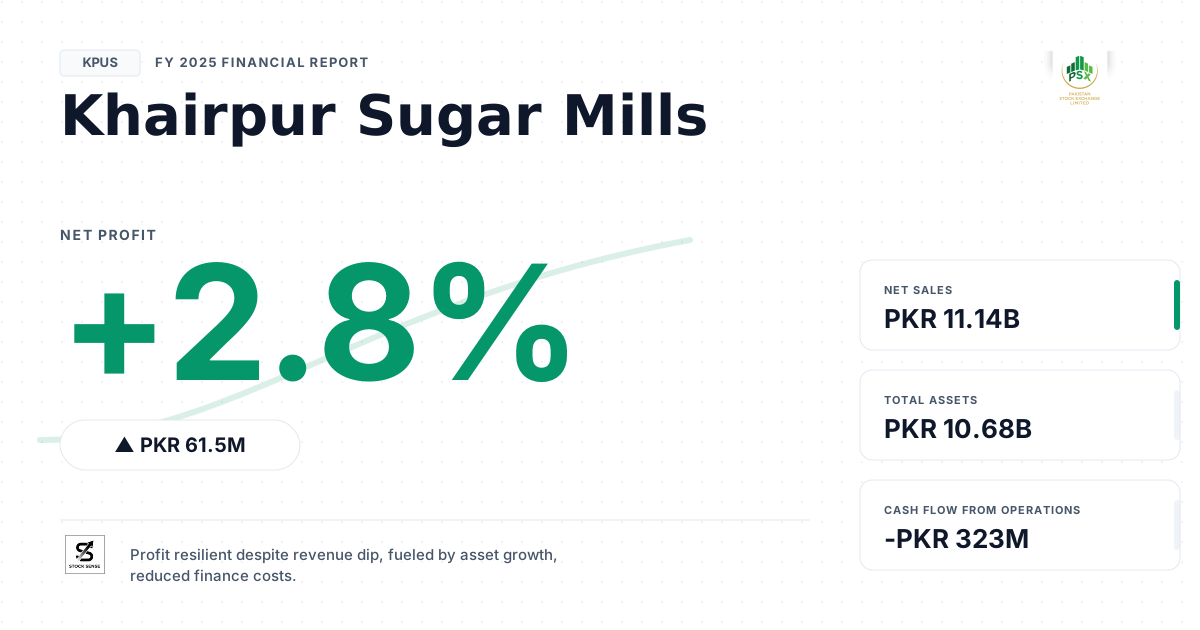
Khairpur Sugar Mills Limited (KPUS) has released its financial results for the year ended September 30, 2025, showcasing a nuanced performance. Despite a modest dip in net sales and operating profit, the company successfully sustained and slightly grew its profit after tax. This resilience was primarily driven by a significant reduction in finance costs and a lower income tax expense. Concurrently, the balance sheet reflects substantial asset growth, largely attributable to a notable revaluation surplus and increased capital expenditure.
Financial Performance Overview
KPUS reported net sales of PKR 11.14 billion for 2025, a marginal decrease of approximately 2.0% from PKR 11.36 billion in 2024. This revenue contraction led to a slight dip in gross profit, falling to PKR 1.14 billion from PKR 1.17 billion in the prior year. Operating expenses, particularly administrative costs, surged by 23.2%, contributing to an 11.1% decline in operating profit, which stood at PKR 735 million compared to PKR 827 million in 2024.
However, a key positive for KPUS shareholders was a significant 17.5% reduction in finance costs, decreasing to PKR 469 million from PKR 568 million. This, combined with a lower income tax expense (PKR 150 million in 2025 vs. PKR 183 million in 2024), enabled the company to report a profit after tax of PKR 61.5 million, a 2.8% improvement over PKR 59.8 million in 2024. Consequently, basic and diluted earnings per share (EPS) edged up to PKR 3.84 from PKR 3.74.
On the balance sheet, total assets expanded impressively by 21.5% to PKR 10.68 billion from PKR 8.79 billion. This growth was largely fueled by a substantial 29.9% increase in Property, Plant and Equipment (PPE), which rose to PKR 6.39 billion from PKR 4.92 billion. Shareholder's equity also grew significantly by 23.1% to PKR 5.00 billion from PKR 4.06 billion, primarily due to a revaluation surplus of PKR 876 million recognized during the year.
Current assets experienced shifts, with a 27.0% decrease in stock in trade, offset by a 54.7% increase in advances and a substantial 166.0% rise in cash and bank balances. Current liabilities, particularly short-term borrowings, increased by 11.9% and 37.2% respectively, indicating a heightened reliance on short-term financing.
A notable concern emerged from the cash flow statement, where cash flow from operations turned negative, showing a net cash outflow of PKR 323 million in 2025. This stands in stark contrast to the PKR 209 million generated in 2024 and was primarily driven by adverse working capital changes.
Key Drivers & Strategic Focus
While segment-specific details are not provided in the financial statements, KPUS's overall performance appears to be influenced by several critical factors:
- Revenue Pressures: The slight decline in net sales suggests potential challenges in pricing, sales volume, or market demand for sugar products, necessitating close monitoring of market dynamics.
- Cost Optimization: Despite an increase in administrative expenses, the significant reduction in finance costs was a crucial factor in safeguarding profitability, highlighting effective financial management.
- Asset Base Enhancement: The substantial revaluation of property, plant, and equipment, coupled with a 145.3% increase in capital expenditure to PKR 298 million (from PKR 121 million in 2024), underscores a strategic focus on strengthening the company's long-term operational capacity and asset backing.
Investor Takeaway
For investors, KPUS presents a mixed but cautiously optimistic outlook. The company's ability to sustain profitability and marginally grow EPS despite revenue headwinds demonstrates operational resilience. The substantial growth in the asset base and equity through revaluation and strategic capital expenditure could be viewed positively for long-term value creation.
However, the negative shift in cash flow from operations and the increased reliance on short-term borrowing warrant close monitoring. Investors should particularly watch for:
- Revenue Trajectory: Signs of recovery and sustained top-line growth in upcoming quarters.
- Operational Efficiency: Management's continued ability to control administrative and other operating expenses.
- Cash Flow Improvement: A significant turnaround in cash flow from operating activities, which is vital for sustainable growth and debt servicing.
- Debt Management: The company's strategy for managing its increased short-term debt and the sustainability of favorable borrowing terms and lower finance costs.
- Dividend Policy: Any future announcements regarding dividend distributions, as no information was disclosed in this report.
Overall, Khairpur Sugar Mills appears to be strategically navigating a challenging economic environment by optimizing its financial structure and investing in its core asset base. However, sustained operational improvements and robust cash flow generation will be paramount for enhancing future shareholder returns.