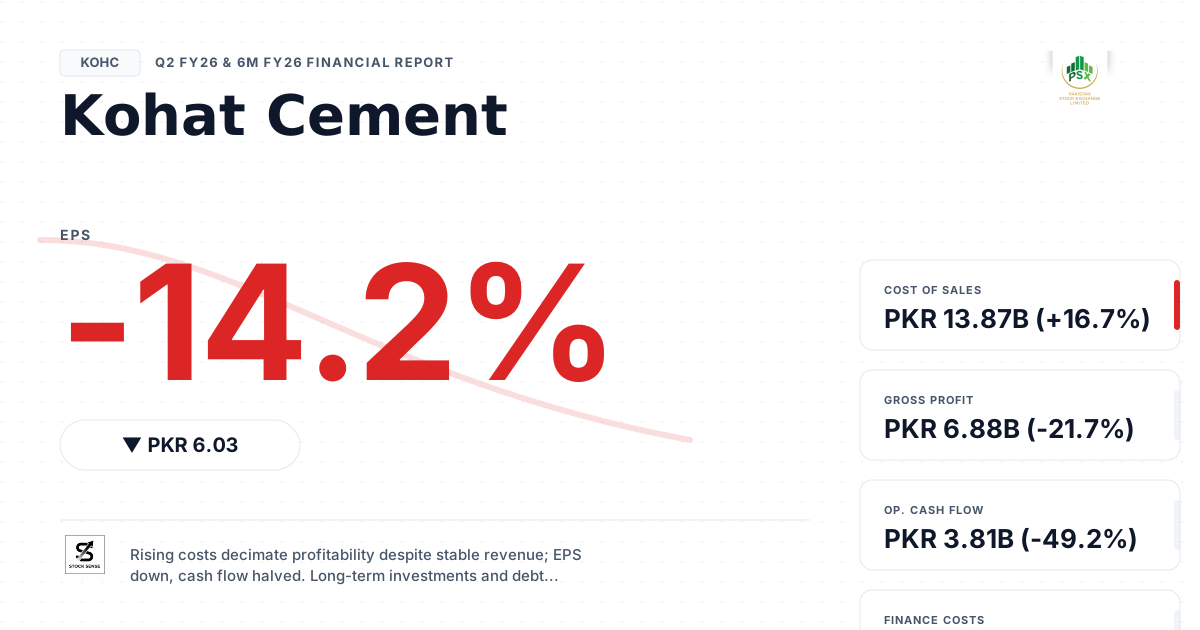
Kohat Cement Company Limited (KOHC) has unveiled its consolidated financial results for the six months and standalone quarter ended December 31, 2025 (Q2 FY26), painting a challenging picture of profitability. Despite a largely stable top-line, the company's earnings were severely eroded by a sharp surge in the cost of sales, leading to a significant decline in earnings per share (EPS) compared to the previous year.
Financial Performance Highlights
For the six months ending December 31, 2025, KOHC reported consolidated net sales of PKR 20.74 billion, a marginal 0.39% increase from PKR 20.66 billion in the corresponding period last year. However, this modest revenue growth was overshadowed by a substantial 16.7% surge in the cost of sales, which escalated to PKR 13.87 billion from PKR 11.88 billion. This directly squeezed the gross profit, which plummeted by 21.7% to PKR 6.88 billion (FY24: PKR 8.78 billion).
The ripple effect of rising costs flowed down the income statement. Operating profit decreased by 23.1% to PKR 5.96 billion (FY24: PKR 7.74 billion). A notable positive was the significant reduction in finance costs, which dropped by 60.9% from PKR 209.75 million to PKR 82.09 million. Despite this, the overall consolidated profit after taxation for the six-month period fell by 19.5% to PKR 5.54 billion, down from PKR 6.88 billion. Consequently, basic and diluted EPS declined by 14.2% to PKR 6.03 from PKR 7.03 year-on-year.
Analyzing the standalone quarter (October-December 2025), a similar trend emerged. Sales experienced a slight 1.2% dip to PKR 10.46 billion from PKR 10.58 billion. Concurrently, the cost of sales surged by 15.6% to PKR 7.07 billion (Q2 FY24: PKR 6.11 billion). This led to a 24.1% reduction in gross profit and a 24.6% decline in profit after taxation for the quarter, with EPS falling by 19.9% to PKR 2.82 from PKR 3.52.
Key Profitability Drivers
The primary culprit behind the squeezed profitability is unequivocally the escalating cost of sales. While the consolidated financial statements do not provide a granular breakdown of specific cost components, the significant increase strongly suggests rising input costs such as fuel, power, or raw materials. The company appears to have struggled to fully pass on these increased costs to consumers or offset them through operational efficiencies. Furthermore, 'Other Income' also saw a 14.1% decrease, from PKR 3.06 billion to PKR 2.62 billion, further contributing to the overall decline in profitability.
Strategic Investments & Financial Health
From a balance sheet perspective, KOHC's consolidated total assets demonstrated robust growth, increasing by 14.4% to PKR 76.41 billion as of December 31, 2025, from PKR 66.79 billion in June 2025. This expansion is partly driven by continued capital expenditure, with Property, Plant & Equipment increasing by approximately PKR 2.98 billion during the six-month period, signaling ongoing investment in operational capacity and future growth. The company also significantly boosted its short-term investments by 25.9% to PKR 33.91 billion (June 2025: PKR 26.94 billion).
In a strategic move, there's a notable shift in the company's debt structure. Long-term financing surged by 127.1% from PKR 1.45 billion to PKR 3.29 billion, while short-term borrowings decreased by 36.2% from an estimated PKR 3.70 billion (June 2025) to PKR 2.36 billion. This indicates a proactive refinancing strategy, favoring longer-term debt to enhance financial stability and reduce reliance on short-term liabilities. However, a concerning trend was the substantial 49.2% decrease in cash generated from operations, falling from PKR 7.52 billion to PKR 3.81 billion, directly reflecting the lower profitability.
The company's announcement explicitly stated that no cash dividend, bonus shares, or right shares were recommended for the period, nor was any other price-sensitive information disclosed, which might disappoint income-focused investors.
Investor Outlook
For investors, KOHC's latest consolidated results present a complex picture. The company's continued investment in assets and strategic debt restructuring suggest a long-term growth vision and prudent financial management. However, the core challenge remains the severe erosion of profit margins. The inability to effectively control or mitigate the sharp rise in the cost of sales is a significant concern that directly impacts shareholder returns and earnings trajectory.
Rational investors should closely monitor KOHC's future strategies for cost control and operational efficiency improvements. The broader outlook for cement demand in Pakistan, coupled with global commodity price trends, will be critical determinants. While the absence of dividends is a short-term disappointment, the focus should be on whether ongoing investments can translate into improved profitability and a stronger earnings trajectory once cost pressures potentially ease. The company's ability to navigate and manage its cost base will be the key factor shaping its future performance and investor confidence.