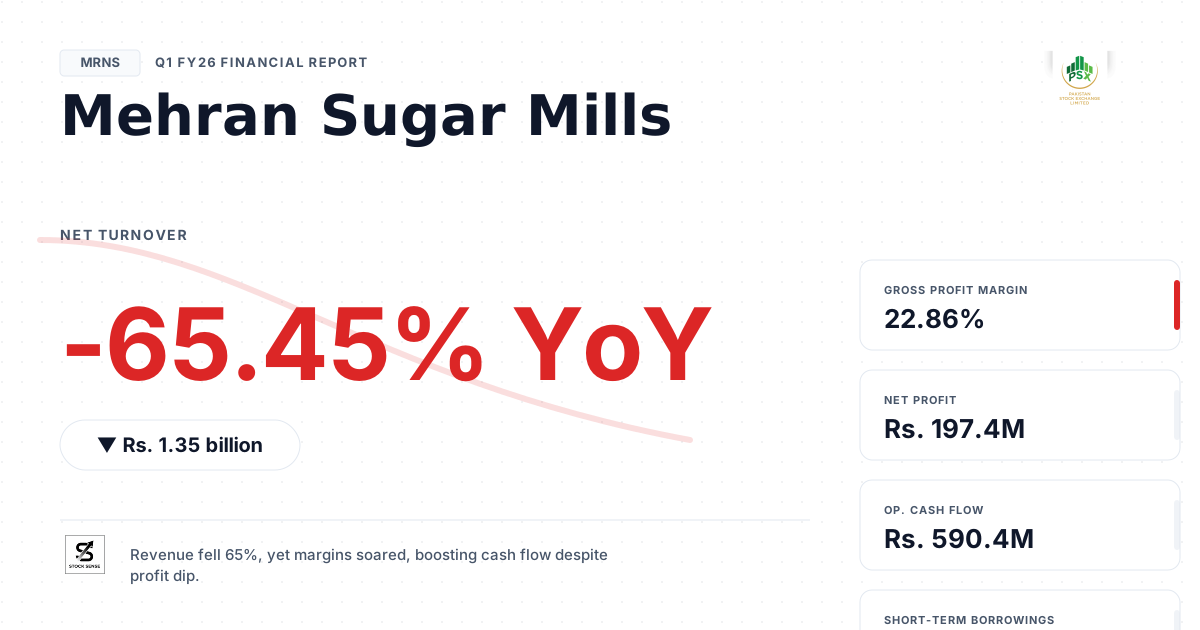
Mehran Sugar Mills Limited (MRNS) has released its unaudited financial results for the first quarter ended December 31, 2025, presenting a compelling narrative of operational resilience amidst a challenging top-line environment. Despite a substantial 65.45% year-on-year decline in net turnover, the company achieved a remarkable surge in gross profit margins and declared a cash dividend of Rs. 1.5 per share (15%), signaling confidence to shareholders. However, the period also saw significant shifts in the balance sheet, notably a sharp increase in short-term borrowings and an unprecedented jump in contract liabilities.
Financial Performance Highlights
The company's net turnover for Q1 FY26 stood at Rs. 1.35 billion, a steep fall from Rs. 3.91 billion reported in the corresponding period last year. This significant reduction in sales volume or pricing was the primary driver of the top-line contraction. Yet, the profitability story diverged sharply from the revenue trend.
Gross profit, while slightly lower in absolute terms at Rs. 308.7 million (Q1 FY26) compared to Rs. 342.0 million (Q1 FY25), witnessed an explosive margin expansion. The gross profit margin surged from a modest 8.75% in Q1 FY25 to an impressive 22.86% in Q1 FY26. This dramatic improvement, representing a 14.11 percentage point increase, suggests robust cost control, favorable pricing dynamics, or an advantageous sales mix, effectively cushioning the impact of lower sales.
Operating profit decreased by 38.54% to Rs. 231.8 million from Rs. 377.1 million year-on-year. However, MRNS benefited significantly from an astonishing 1665% increase in its share of profit from associates, which soared from Rs. 3.8 million to Rs. 67.1 million. Furthermore, finance costs saw a remarkable 75.86% reduction, plummeting from Rs. 96.1 million to just Rs. 23.2 million, likely due to lower interest rates or improved debt management.
Despite these positive factors, profit before taxation experienced only a slight 3.23% dip to Rs. 275.6 million from Rs. 284.8 million. The net profit for the period ultimately decreased by 13.08% to Rs. 197.4 million (EPS Rs. 2.63) compared to Rs. 227.1 million (EPS Rs. 3.03) in the prior year. This decline was primarily attributable to a substantial taxation charge of Rs. 58.6 million in Q1 FY26, contrasting sharply with a tax credit of Rs. 6.4 million in Q1 FY25.
Balance Sheet Dynamics and Cash Flow
The balance sheet reflects substantial growth, with total assets expanding by 38.46% from Rs. 7.41 billion (September 30, 2025) to Rs. 10.26 billion (December 31, 2025) within just three months. This was largely fueled by a significant increase in current assets, particularly stock-in-trade, which surged by 272.28% from Rs. 368 million to Rs. 1.37 billion, and short-term investments, rising by 60.08% from Rs. 2.43 billion to Rs. 3.89 billion.
However, current liabilities also saw a dramatic increase. Short-term borrowings soared by 261.34% from Rs. 476 million to Rs. 1.72 billion. Most strikingly, contract liabilities experienced an unprecedented jump of over 72,000%, from Rs. 1.7 million to Rs. 1.23 billion, indicating a significant shift in customer advances or contractual obligations.
Cash flow from operating activities demonstrated strong improvement, generating Rs. 590.4 million in Q1 FY26, a 56.35% increase from Rs. 377.6 million in Q1 FY25, highlighting healthy operational cash generation despite lower sales. While total cash used in investing activities decreased year-on-year, the company significantly ramped up its fixed capital expenditure by 641.7%, from Rs. 36.9 million to Rs. 273.7 million, signaling ongoing investment in productive capacity.
Key Strategic Drivers
- Enhanced Operational Efficiency: The dramatic improvement in gross profit margin underscores effective cost management or favorable market conditions for sugar pricing.
- Strategic Inventory & Treasury Management: The substantial increase in stock-in-trade suggests inventory building, possibly in anticipation of future demand or price movements. The rise in short-term investments points to active treasury management.
- Explosive Associate Contributions: A staggering increase in the share of profit from associates provided a critical boost to the bottom line.
- Prudent Debt Management: Significantly reduced finance expenses played a crucial role in sustaining profitability despite the revenue decline.
Management Signals and Investor Outlook
The declaration of a 15% cash dividend (Rs. 1.5 per share) reflects management's confidence in the company's underlying financial health and its commitment to shareholder returns, even with a reduced net profit for the quarter. The substantial increase in fixed capital expenditure suggests a long-term vision for growth and capacity enhancement. However, the significant surge in short-term borrowings and the unprecedented rise in contract liabilities indicate increased reliance on debt financing for working capital or investment needs. This led to a deepening of the net negative cash and cash equivalents balance, which worsened from Rs. 440.6 million at the start of the quarter to Rs. 1.61 billion by period-end.
For investors, Mehran Sugar Mills presents a complex but intriguing picture. The robust gross margin improvement, strong operating cash flow, and the dividend payout are positive indicators of operational strength and shareholder focus. However, the sharp decline in revenue, coupled with the significant increase in short-term debt and the deepening negative cash equivalent balance, warrants close attention regarding potential liquidity risks and future revenue generation strategies.
Going forward, investors should closely monitor the sustainability of the improved margins, the company's strategy for revenue growth, and its approach to managing its evolving debt and liability profile. The market's reaction to the dividend and the company's ability to convert its increased stock-in-trade into profitable sales will be key catalysts to watch in the coming quarters.