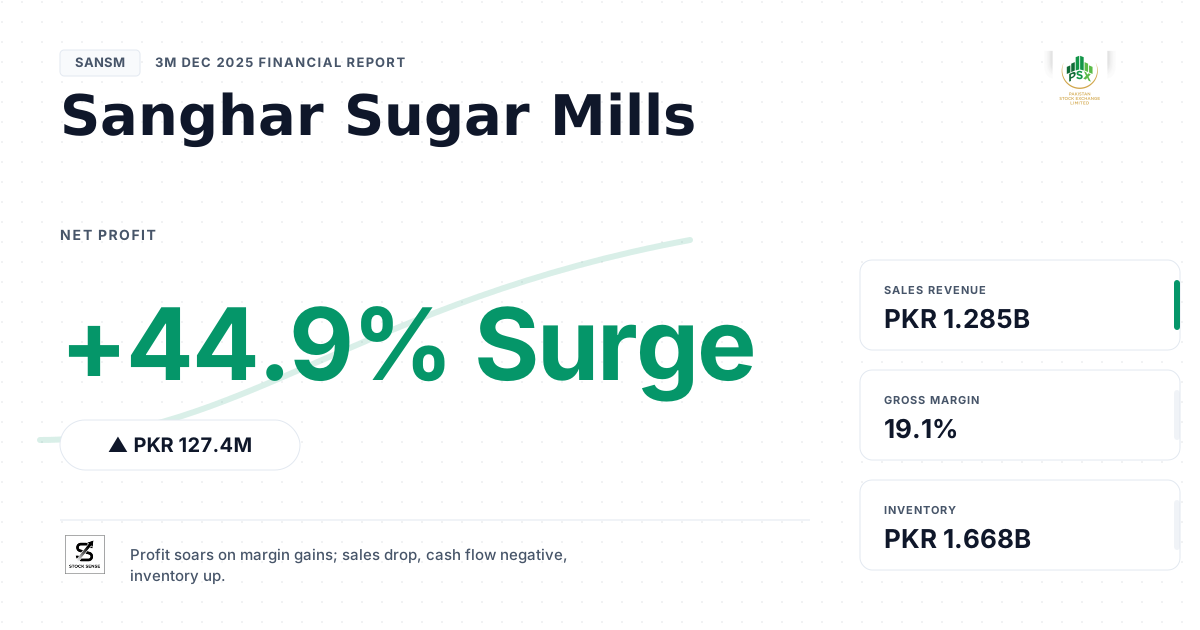
Sanghar Sugar Mills Limited (SANSM) has announced its financial results for the three months ended December 31, 2025, revealing a remarkable 44.9% surge in net profit despite a significant 45.2% drop in sales revenue. While the company delivered a robust increase in earnings per share, investors should closely examine the absence of a dividend and a substantial shift in working capital dynamics, notably a massive 238% increase in inventory and an almost 12-fold jump in short-term borrowings.
Financial Performance Highlights
The company’s sales revenue for the quarter stood at PKR 1.285 billion, a notable decrease from PKR 2.343 billion in the same period last year. However, this revenue dip was more than offset by a sharper 51.1% reduction in the cost of sales, which fell from PKR 2.125 billion to PKR 1.040 billion. This strategic cost management led to a remarkable expansion in gross profit, rising from PKR 218.7 million to PKR 245.5 million, and a significant improvement in gross margin from approximately 9.3% to an impressive 19.1%.
Operating expenses were also managed effectively, decreasing by 6.7% from PKR 67.5 million to PKR 63.0 million. This, combined with the strong gross profit, propelled operating profit up by 20.8% to PKR 182.5 million from PKR 151.2 million previously. Finance costs saw a substantial 55.3% reduction, dropping from PKR 30.4 million to PKR 13.6 million, further bolstering the bottom line. Despite a higher taxation expense of PKR 42.2 million (a stark contrast to a tax credit of PKR 6.3 million last year), the company reported a profit for the period of PKR 127.4 million, a healthy increase from PKR 87.9 million in the corresponding quarter. Earnings per share (EPS) consequently rose to PKR 10.66 from PKR 7.36.
On the balance sheet, total assets increased by 25.0% to PKR 7.528 billion from PKR 6.020 billion as of September 30, 2025. This growth was primarily driven by a substantial increase in current assets, particularly stock-in-trade, which surged from PKR 493.4 million to PKR 1.668 billion. Cash and bank balances also saw a significant boost of 308.6% from PKR 107.0 million to PKR 437.2 million. However, current liabilities also rose sharply, mainly due to a 53.7% increase in trade and other payables (from PKR 1.175 billion to PKR 1.806 billion) and a significant jump in short-term borrowings from PKR 63.3 million to PKR 817.5 million.
Cash flow from operating activities turned negative, showing an outflow of PKR 410.9 million, a stark reversal from an inflow of PKR 795.2 million in the prior year. This significant shift was largely attributable to the massive increase in stock-in-trade. The company relied heavily on financing activities, with net cash inflows of PKR 643.8 million, primarily from increased short-term borrowings (PKR 654.1 million), to fund its substantial working capital needs.
Key Drivers & Strategic Implications
While the report does not provide a detailed breakdown by business segment, the dramatic improvement in gross margins despite lower sales volume points to a few potential drivers for SANSM's performance:
- Favorable Raw Material Costs: Significantly lower sugarcane prices during the crushing season likely boosted profitability per unit.
- Operational Efficiency: Improved efficiencies in the sugar production process contributed to cost reduction.
- Strong Selling Prices: Potentially higher selling prices for sugar relative to the cost of production, even with reduced sales volume, played a role.
The substantial increase in stock-in-trade suggests either an expectation of higher future sugar prices, a slower-than-anticipated sales cycle, or an aggressive procurement strategy for raw materials to capitalize on favorable input costs.
Management Actions & Investor Takeaway
The Board of Directors has recommended 'Nil' for cash dividend, bonus shares, or any other entitlement for the period. This decision, despite the improved profitability, indicates a focus on retaining earnings within the company, possibly to strengthen the balance sheet or fund future working capital requirements. Capital expenditure remained notably low during the quarter, with additions to property, plant, and equipment totaling only PKR 2.85 million (an 80.8% decrease from PKR 14.85 million last year), suggesting no major expansion plans were underway.
The significant reliance on short-term borrowings to finance the surge in inventory and other working capital needs is a key management decision that impacts the company's financial structure and future interest expense exposure, especially in a rising interest rate environment.
For investors, Sanghar Sugar Mills' latest results present a mixed but intriguing picture. The sharp improvement in profitability and EPS is a clear positive, signaling strong operational efficiency and potentially favorable market conditions for sugar margins. The substantial reduction in finance costs also bodes well for future earnings.
However, the significant decline in sales revenue and the negative operating cash flow, driven by a massive inventory build-up funded by short-term debt, introduce an element of risk. A rational investor should closely monitor:
- Inventory Conversion: The company's ability to convert its substantially increased inventory into sales at profitable prices in the coming quarters.
- Margin Sustainability: The sustainability of the improved gross margins, as these were the primary driver of the profit surge.
- Working Capital Management: The company's strategy for managing working capital and its ability to reduce reliance on high-cost short-term borrowings.
- Dividend Policy: Any future announcements regarding dividends, which were absent this quarter despite strong earnings, indicating a potential shift in capital allocation priorities.
While the profit growth is commendable, the underlying cash flow dynamics and the lack of a dividend warrant careful consideration for both existing and potential shareholders, highlighting a need for vigilance amidst the positive earnings report.