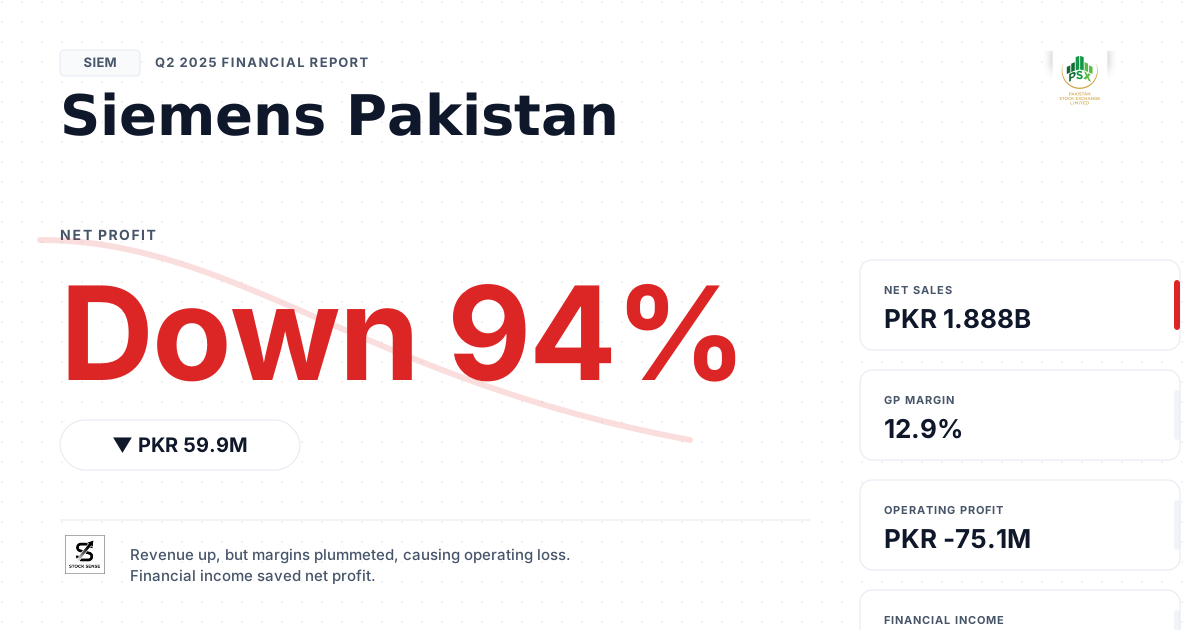
Siemens (Pakistan) Engineering (SIEM) has reported a challenging quarter ending December 31, 2025. While the company saw healthy revenue growth, a sharp deterioration in gross profit margins led to a significant decline in operational profitability. However, a substantial increase in financial income provided a crucial cushion, preventing a much steeper drop in net profit for the period.
Financial Performance Overview
Net sales and services for Siemens (Pakistan) Engineering (SIEM) demonstrated resilience, climbing 18.5% year-on-year to PKR 1.888 billion in Q2 2025, up from PKR 1.593 billion in Q2 2024. However, this positive top-line performance was overshadowed by a severe contraction in profitability. Gross profit plummeted by a staggering 60.8% to PKR 242.8 million from PKR 620.1 million in the prior year, causing the gross profit margin to shrink dramatically from 38.9% to a mere 12.9%.
This sharp margin compression transformed an operating profit of PKR 395.3 million in Q2 2024 into an operating loss of PKR 75.1 million in Q2 2025. The quarter's saving grace was a phenomenal 1,113% surge in net financial income, which soared from PKR 11.1 million to PKR 134.2 million, likely a direct benefit of the company's substantial cash reserves in a high-interest rate environment. Despite this crucial financial buffer, profit before tax from continuing operations fell sharply from PKR 406.4 million to PKR 59.1 million. Consequently, net profit from continuing operations dropped to PKR 59.9 million (PKR 7.27 EPS) from PKR 318.3 million (PKR 38.60 EPS) in the prior year. The overall net profit for the period, which included significant discontinued operations last year, saw an even more pronounced fall from PKR 1.007 billion to PKR 59.9 million.
On a more positive note, cash flow from operations showed a remarkable turnaround. Net cash generated from operating activities swung from a negative PKR 665.3 million in Q2 2024 to a positive PKR 417.5 million in Q2 2025. The company's cash and bank balances further strengthened, reaching PKR 7.250 billion as of December 31, 2025, an increase from PKR 6.711 billion at the end of the previous quarter. The balance sheet remains robust, with total equity showing a slight increase, underscoring financial stability despite operational headwinds.
Key Drivers & Operational Pressures
The primary culprit behind the quarter's challenging profitability is the substantial 69.1% year-on-year increase in the cost of sales (from PKR 973.1 million to PKR 1.645 billion), which far outpaced revenue growth and directly led to the sharp decline in gross margins. This suggests significant rising input costs, a shift in product mix towards lower-margin offerings, or operational inefficiencies. While specific segment details are not disclosed in this interim statement, the overarching trend points to intense cost pressures impacting SIEM's core engineering and services business.
- Beyond direct costs, other operational expenses also rose:
- Marketing and selling expenses increased by 25.8% from PKR 219.2 million to PKR 275.8 million.
- General administrative expenses surged by 197% from PKR 17.6 million to PKR 52.4 million, indicating significant overhead growth.
- The positive impact from the reversal of expected credit losses decreased significantly from PKR 31.4 million to PKR 12.2 million, contributing less favorably to the bottom line.
Strategic Posture & Investor Outlook
Capital expenditure for the quarter saw a notable increase of 181% to PKR 26.7 million from PKR 9.5 million in the same period last year, signaling continued, albeit modest, investment in property, plant, and equipment. The company's formidable cash position remains a key strength, clearly evidenced by the substantial financial income generated. As is common with interim reports, no explicit forward-looking statements or guidance were provided, nor was there any mention of dividends for the period, leaving investors to await further clarity on capital allocation.
Investor Takeaway
For investors, the immediate concern is the dramatic contraction of gross profit margins. While revenue growth is encouraging, the sustainability of profitability relies heavily on the company's ability to manage its cost of sales effectively. The significant financial income is currently a key support for the bottom line, but investors should view this as a temporary buffer rather than a core operational strength.
Moving forward, rational investors should closely monitor management's commentary on the reasons behind the margin erosion and any strategies to address it. Key catalysts to watch include any improvements in operational efficiency, a more favorable cost environment, or strategic deployment of the company's substantial cash reserves into growth-driving initiatives. The absence of a dividend announcement means investors will need to await further updates on capital allocation.