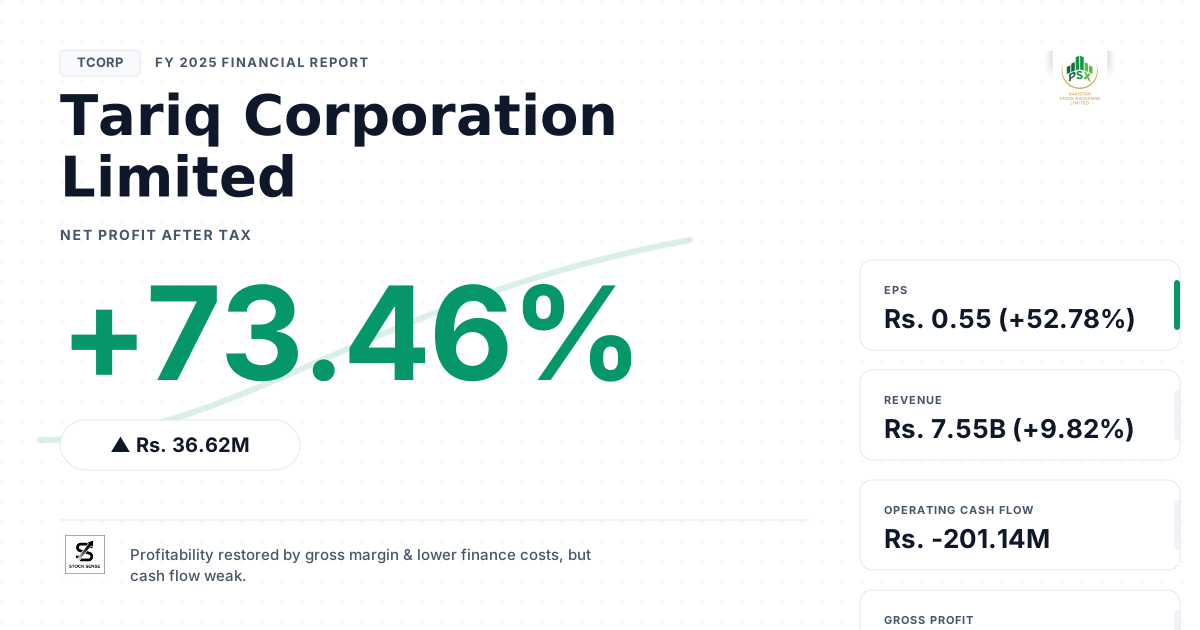
Tariq Corporation Limited (TCORP) has announced its financial results for the year ended September 30, 2025, marking a significant operational turnaround. The company successfully swung from a substantial loss before tax to a net profit, with a notable increase in its Earnings Per Share. Despite this positive shift, the Board of Directors has opted against recommending any cash dividend, bonus, or right shares, signaling a focus on internal strengthening. Furthermore, a strategic move to increase authorized share capital indicates future growth ambitions.
Financial Performance Highlights: A Return to the Black
The most compelling aspect of TCORP's performance is its return to overall profitability. The company reported a net profit after tax of Rs. 36.62 million for FY25, a substantial 73.46% increase from Rs. 21.12 million in the previous year. This translated into an Earnings Per Share (EPS) of Rs. 0.55, up 52.78% from Rs. 0.36 in FY24.
Revenue from contracts with customers (net) demonstrated solid growth, increasing by 9.82% to Rs. 7.55 billion, up from Rs. 6.88 billion last year. More impressively, TCORP reversed a gross loss of Rs. 419.13 million in FY24 to achieve a gross profit of Rs. 198.83 million in FY25. This dramatic shift underscores a significant recovery in core operational efficiency and cost management. This positive momentum flowed through the income statement, transforming a loss before tax of Rs. 309.18 million into a profit before tax of Rs. 116.66 million.
Finance costs were a major contributor to the improved bottom line, plummeting by 44.56% from Rs. 277.57 million to Rs. 153.88 million. However, not all indicators were positive; other income decreased by 31.28% to Rs. 555.52 million. A particularly noteworthy concern is the 'Other operating expenses,' which surged by an alarming 691.2% from Rs. 2.33 million in FY24 to Rs. 18.45 million in FY25, an area that warrants closer examination.
Despite the profit turnaround, cash flow from operations turned negative, registering an outflow of Rs. 201.14 million in FY25, a stark contrast to an inflow of Rs. 190.07 million in FY24. This reversal was primarily driven by adverse changes in working capital, notably significant increases in trade and other receivables and advances, deposits, and prepayments.
On the balance sheet, total assets saw a modest increase of 1.77% to Rs. 8.60 billion. Current assets experienced a robust 21.11% rise to Rs. 3.32 billion, largely due to higher receivables and advances. Conversely, non-current assets, particularly Property, Plant, and Equipment, decreased by 7.58%. Total equity expanded by 2.12% to Rs. 3.85 billion. Long-term finance liabilities were significantly reduced by 62.83% to Rs. 124.66 million, contributing to a healthier debt profile.
Key Drivers and Strategic Moves
The primary catalysts for TCORP's improved financial performance are clearly a stronger gross margin and effective control over finance costs. The remarkable swing from a gross loss to a gross profit suggests enhanced efficiency in the cost of revenue, potentially coupled with improved pricing power or a more favorable sales mix. The substantial reduction in finance costs points to successful debt management initiatives or more favorable interest rate environments.
Cash flow from investing activities generated a significant inflow of Rs. 449.06 million. This was mainly attributable to 'Capital work in progress disposed off / (incurred) - net' and 'Proceeds from disposal of operating fixed assets,' indicating strategic asset rationalization or the monetization of completed projects, which positively impacted liquidity from non-operational sources.
Management's Capital Allocation and Future Intent
The Board of Directors' decision to recommend no cash dividend, bonus issue, or right shares, despite the return to profitability, suggests a prudent approach to capital allocation. This strategy likely prioritizes internal reinvestment, working capital management, or further balance sheet strengthening over immediate shareholder distributions.
A key strategic signal is the Board's recommendation to increase the authorized share capital from Rs. 850 million to Rs. 1,150 million. While no immediate issuance has been announced, this proactive step positions the company for potential future capital raising initiatives, such as a rights issue. Such a move could fund expansion, further reduce debt, or bolster working capital requirements. This recommendation is subject to shareholder approval at the upcoming Annual General Meeting on January 28, 2026.
Investor Takeaway: A Mixed but Promising Outlook
For investors, TCORP's latest results present a mixed but generally positive picture of resilience and recovery. The decisive turnaround to profitability, coupled with improved EPS, are strong indicators of operational recovery and more effective financial management, particularly in gross margins and finance costs. This marks a significant and welcome improvement from the previous year's losses.
However, the absence of dividends despite the profit, alongside the negative operating cash flow, warrants careful attention. The negative operating cash flow suggests that while TCORP is profitable on paper, it faces ongoing challenges in converting those profits into immediate cash from its core operations, largely due to increased working capital needs. The alarming surge in 'Other operating expenses' also requires investor scrutiny. Investors should closely monitor the company's working capital management and expense control in the coming quarters.
The proposed increase in authorized share capital is a forward-looking and strategic move. While it doesn't imply immediate dilution, it clearly signals management's intent to potentially raise capital in the future. Investors should remain vigilant for any subsequent announcements regarding the purpose and timing of such capital increases, as these could significantly influence the company's growth trajectory and shareholder structure.