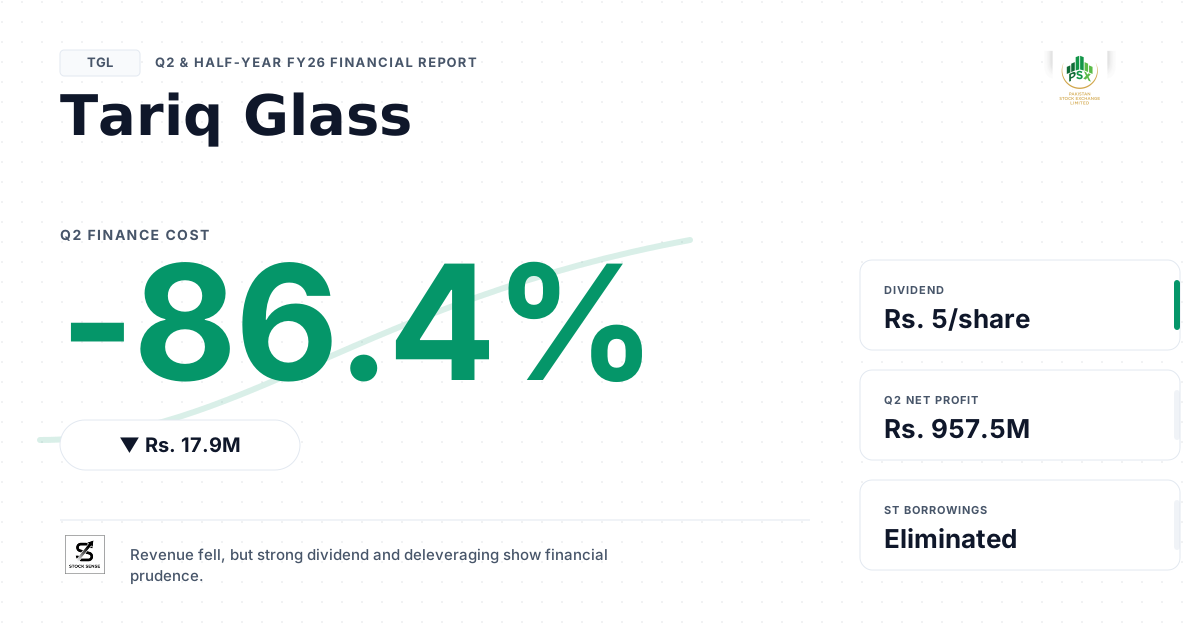
Tariq Glass Industries Limited (TGL) has announced its financial results for the second quarter and half-year ended December 31, 2025, presenting a nuanced picture for investors. While the company experienced a notable decline in both quarterly and half-yearly revenue and net profit compared to the previous year, shareholders will be reassured by an interim cash dividend of Rs. 5 per share (50%). Crucially, TGL has made significant strides in strengthening its balance sheet, particularly by drastically reducing its finance costs and eliminating short-term borrowings, signaling a robust focus on financial prudence amidst a challenging operating environment.
Financial Performance Overview
For the second quarter (Q2 FY26), TGL reported revenue of Rs. 7.03 billion, a significant 26.5% decrease compared to Rs. 9.55 billion in Q2 FY25. This top-line pressure led to lower profitability, with gross profit falling by 38.3% to Rs. 1.98 billion and net profit declining by 38.7% to Rs. 957.5 million. Consequently, earnings per share (EPS) for the quarter stood at Rs. 5.56, down from Rs. 9.06 in the corresponding period last year.
Looking at the half-year (HY FY26), revenue decreased by 11.6% to Rs. 14.53 billion from Rs. 16.44 billion in HY FY25. Gross profit for the half-year saw a 25.2% reduction to Rs. 3.77 billion, while net profit declined by 18.8% to Rs. 1.84 billion. Half-year EPS was Rs. 10.70, compared to Rs. 13.16 in the prior year.
Despite the revenue and profit dip, a standout positive was the dramatic reduction in finance costs. These plummeted by an impressive 86.4% in Q2 FY26 to just Rs. 17.9 million, compared to Rs. 131.2 million in Q2 FY25. For the half-year, finance costs were down 85.1% to Rs. 45.0 million from Rs. 300.8 million, demonstrating successful debt management and significantly cushioning the impact of lower sales on the bottom line.
Strengthening the Balance Sheet
TGL's balance sheet reflects considerable improvement and strategic deleveraging. Total assets increased slightly to Rs. 28.49 billion as of December 31, 2025, from Rs. 27.82 billion in June 2025. Shareholders' equity grew robustly to Rs. 24.26 billion from Rs. 22.42 billion over the same period. More notably, current liabilities decreased by approximately Rs. 972 million, with short-term borrowings completely eliminated by December 2025, down from Rs. 162.3 million in June 2025. Cash and bank balances more than doubled, soaring to Rs. 2.13 billion from Rs. 0.95 billion in June 2025, indicating robust liquidity and improved cash management.
Key Drivers & Strategic Focus
While the financial statements do not provide a detailed breakdown of performance by specific product lines (e.g., tableware, opalware, or float glass), the overall decline in revenue suggests a challenging operating environment, likely influenced by broader economic slowdown or increased competition in the glass industry. However, TGL's proactive management of its financial structure has been a critical counter-balance.
The most significant positive driver for profitability was the dramatic reduction in finance costs, a direct result of successful debt management and potentially lower interest rates or a shift in financing structure. This substantial saving has significantly improved the company's financial health and resilience.
The Board's decision to approve a substantial interim cash dividend of Rs. 5 per share (50%) for the financial year ending June 30, 2026, underscores their confidence in the company's underlying financial health and future prospects, despite the recent dip in earnings. This commitment to consistent shareholder returns is a strong signal to the market.
Strategically, TGL has significantly de-risked its balance sheet. The complete elimination of short-term borrowings and a reduction in long-term finances (from Rs. 453.4 million to Rs. 340.6 million) enhance financial stability and reduce vulnerability to interest rate fluctuations. The company also continued to invest in its assets, with payments for property, plant, and equipment increasing by 147.8% in the half-year, rising to Rs. 379.1 million from Rs. 153.0 million in the prior half-year, indicating ongoing commitment to operational capacity.
Investor Takeaway
For investors, TGL's latest results present a nuanced picture. While the decline in top-line and bottom-line performance is a concern, the robust interim dividend and the impressive deleveraging of the balance sheet offer significant reassurance. The company appears to be prioritizing financial prudence, operational efficiency, and consistent shareholder returns, positioning itself for long-term stability.
Going forward, investors should closely monitor:
- The trajectory of revenue growth and efforts to regain market share in a competitive and potentially challenging economic environment.
- The sustainability of improved margins and cost efficiencies, particularly the low finance cost, as interest rates may fluctuate.
- Any further announcements regarding expansion plans or new product developments that could drive future growth.
- The company's ability to maintain strong cash generation to support future dividends and strategic investments.
TGL's strategic focus on financial strength and shareholder value positions it as an interesting stock for those valuing stability and consistent returns in a volatile market.