Tariq Corporation Limited (TCORP) reported a challenging first quarter for fiscal year 2025, marked by modest revenue growth overshadowed by a severe contraction in net profit. The results underscore significant operational hurdles, as escalating costs eroded margins despite a notable boost from other income and reduced finance expenses. Investors will be keenly observing the company's strategies to restore profitability and manage its expanding working capital requirements in the upcoming quarters.
Financial Performance Overview
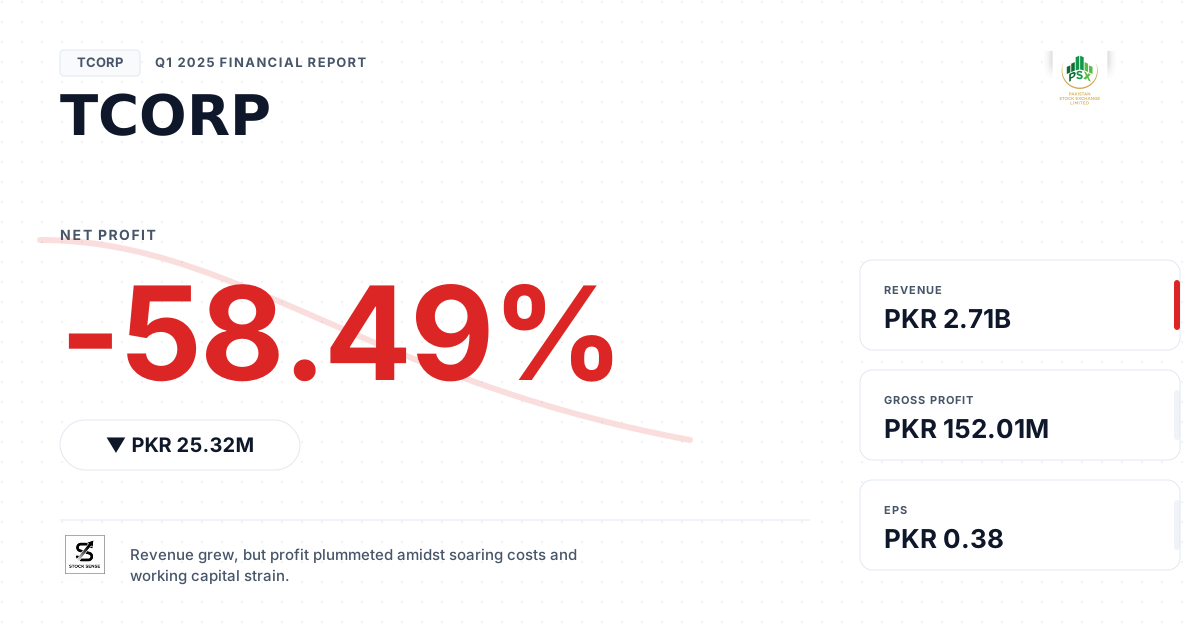
TCORP's net revenue from contracts with customers demonstrated a robust 5.06% year-on-year growth, reaching PKR 2.71 billion in Q1 2025 compared to PKR 2.58 billion in Q1 2024. This indicates continued sales activity. However, despite this revenue expansion, gross profit sharply declined by 10.00% to PKR 152.01 million, down from PKR 168.89 million in the prior year. Consequently, the gross profit margin contracted by nearly a full percentage point, from 6.54% in Q1 2024 to 5.60% in Q1 2025, signaling intense pressure on product pricing or an increase in the cost of goods sold.
Operational efficiency came under significant pressure, with administrative and general expenses surging by a substantial 46.71% from PKR 57.63 million to PKR 84.55 million. This contributed to a 36.75% increase in total operating expenses. As a result, profit from operations plummeted by 41.35% to PKR 59.29 million, compared to PKR 101.10 million in Q1 2024. A notable positive was that other income surged by an impressive 134.72%, more than doubling from PKR 13.74 million to PKR 32.25 million, which helped cushion the operational decline. Finance costs also saw a welcome 20.74% reduction, decreasing from PKR 43.24 million to PKR 34.27 million.
Despite these offsets, profit before tax declined by 26.82% to PKR 23.32 million. Crucially, the company recorded an income tax credit of PKR 2.00 million in Q1 2025, a stark contrast to the income tax expense of PKR 29.14 million in Q1 2024. While this tax benefit provided some relief, it could not prevent the overall profit after tax from plummeting by 58.49% to PKR 25.32 million. Earnings per share (EPS) mirrored this sharp decline, dropping from PKR 0.92 in Q1 2024 to PKR 0.38 in Q1 2025, a 58.70% reduction.
The balance sheet, comparing December 2025 to September 2025, reveals a substantial increase in current assets, particularly stock-in-trade, which surged by an astonishing 402.3% from PKR 211.22 million to PKR 1.06 billion. Current liabilities also rose sharply, mainly driven by a significant increase in contract liabilities, which more than doubled by 116.6% from PKR 437.11 million to PKR 946.75 million, and short-term borrowings, soaring by 278.8% from PKR 176.35 million to PKR 668.15 million. This indicates a substantial expansion in working capital requirements.
Cash flow from operations turned significantly more negative, with a net cash outflow from operations worsening by 75.13% to PKR 306.21 million compared to PKR 174.85 million in the same quarter last year, largely due to adverse working capital changes. The company relied heavily on financing activities, generating PKR 483.11 million, a 29.75% increase year-on-year, primarily through new short-term borrowings, to manage its liquidity.
Key Drivers & Strategic Signals
The condensed interim financial statements do not provide a breakdown by specific business segment or product line, making it challenging to pinpoint the exact drivers for the revenue growth or the significant increase in operating costs. However, the substantial increase in stock-in-trade and contract liabilities suggests increased operational activity or anticipation of future sales, requiring higher inventory levels and potentially reflecting advance payments for ongoing contracts.
The Board of Directors declared no cash dividend, bonus issue, or right shares for the quarter, reflecting the current challenging profitability and the need to conserve cash. The significant increase in long-term loans, increasing by 28.0% from PKR 177.61 million to PKR 227.31 million, and short-term borrowings, which surged by 278.8% from PKR 176.35 million to PKR 668.15 million, indicates the company is taking on more debt to finance its operations and increased working capital needs. Additions to property, plant, and equipment also saw a substantial 68.67% increase, rising to PKR 64.28 million this quarter from PKR 38.11 million in the prior year, suggesting ongoing investment in fixed assets.
Investor Takeaway
TCORP's Q1 2025 results present a mixed picture for investors: modest revenue growth is overshadowed by a sharp decline in profitability, primarily due to rising operating costs and squeezed gross margins. The reliance on increased other income and the income tax credit to partially offset operational weakness is not a sustainable long-term strategy for value creation.
Investors should closely monitor the company's ability to improve its operational efficiency and restore gross margins in the coming quarters. The significant increase in working capital requirements, particularly inventory and contract liabilities, coupled with a substantial rise in borrowings, warrants attention. While it could signal growth, it also poses liquidity risks if not managed effectively. The absence of any dividend declaration underscores the current profitability challenges, and future dividend prospects will hinge on a sustained turnaround in net earnings. Key areas to watch in upcoming reports include gross margin trends, control over administrative expenses, working capital management, and the trajectory of debt levels.