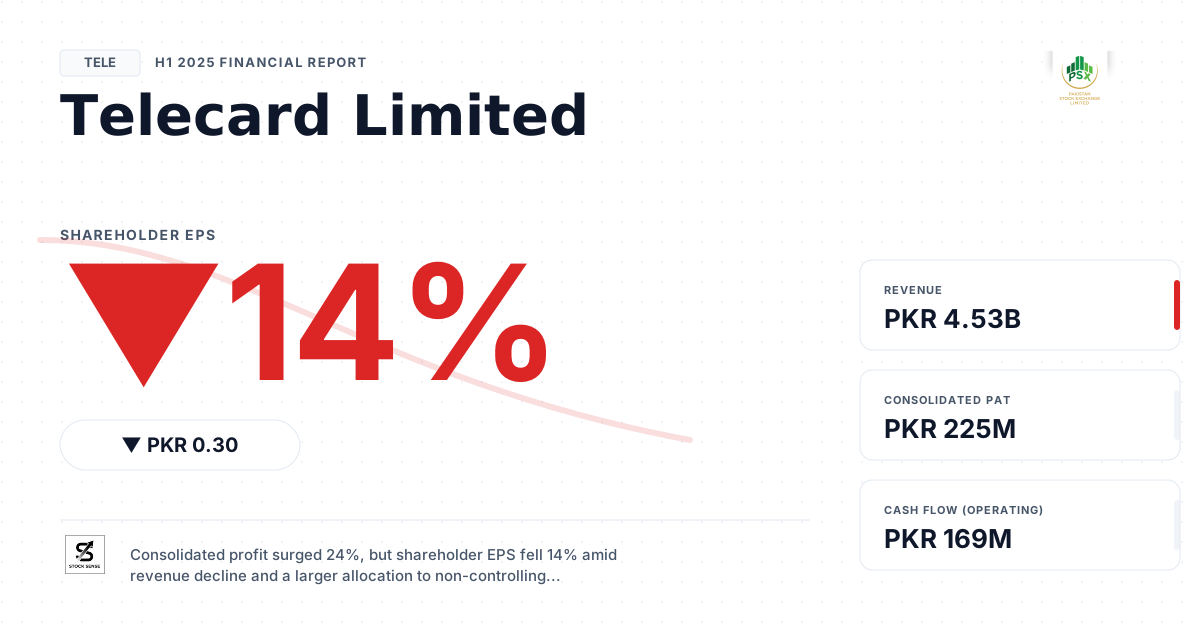
Telecard Limited (TELE) has released its half-yearly financial results for the period ended December 31, 2025, painting a complex picture for investors. Despite a commendable 24% surge in consolidated profit after tax, the earnings per share (EPS) attributable to the company's shareholders surprisingly fell by 14% to PKR 0.30. This notable divergence stems from a significantly larger portion of profits being allocated to non-controlling interests, coupled with a substantial decline in overall revenue.
Financial Performance Overview
The company's consolidated net revenue for H1 2025 stood at PKR 4.53 billion, marking a significant 16% decrease compared to PKR 5.41 billion reported in the same period last year. The second quarter (Q2 2025) alone witnessed an even sharper contraction, with revenue plummeting 33% year-on-year to PKR 2.15 billion, underscoring persistent top-line challenges.
Despite the revenue contraction, Telecard demonstrated improved operational efficiency. Consolidated gross profit rose by 7% to PKR 1.23 billion from PKR 1.15 billion, leading to a healthy expansion in gross margin from 21.3% to 27.2%. This positive trend extended to the operating level, with consolidated operating profit increasing by 17.6% to PKR 456 million, and the operating margin improving from 7.2% to 10.1%.
Consolidated Profit After Tax (PAT) for H1 2025 grew by 24% to PKR 225 million, up from PKR 181 million. However, the profit attributable to the owners of the Holding Group actually decreased by 15% to PKR 101 million (from PKR 119 million), while the share allocated to non-controlling interests more than doubled to PKR 124 million (from PKR 62 million). This significant shift directly impacted the EPS, which declined from PKR 0.35 to PKR 0.30.
Cash flow from operating activities experienced a notable reduction, dropping by 37% to PKR 169 million from PKR 269 million in H1 2024. This, combined with cash utilized in investing and financing activities, resulted in a net decrease in cash and cash equivalents of PKR 82 million for the half-year, a reversal from the prior year's net increase.
On the balance sheet, total assets grew by 8.4% to PKR 9.89 billion as of December 31, 2025, compared to June 30, 2025. Total equity also increased by 4.5% to PKR 5.10 billion. Encouragingly, long-term financing decreased by nearly 25% to PKR 231 million, indicating a strategic reduction in long-term debt. However, current liabilities increased by 17% to PKR 4.48 billion, primarily driven by a rise in trade and other payables.
Key Drivers & Strategic Implications
While the financial statements do not provide a detailed breakdown of segment performance, the improved gross and operating margins, despite the revenue decline, suggest that Telecard is effectively managing costs or strategically shifting towards higher-margin services within its diverse portfolio. The substantial increase in profit attributable to non-controlling interests is a pivotal, albeit unexpected, driver of the consolidated PAT growth, implying that a significant portion of the group's profitability is now stemming from subsidiaries where Telecard does not hold full ownership.
Management Actions & Future Signals
Capital expenditure on property, plant, and equipment was lower in H1 2025 at PKR 107 million, compared to PKR 197 million in H1 2024, signaling a more conservative approach to investments. The reduction in both long-term and short-term financing is a positive step towards strengthening the balance sheet and reducing overall financial leverage.
The Board of Directors did not recommend any cash dividend, bonus shares, or right shares for the period, a crucial point for income-focused investors. No specific forward-looking guidance or strategic hints were disclosed in this financial announcement.
Investor Takeaway
For Telecard investors, H1 2025 presents a complex and nuanced narrative. While the overall consolidated profitability of the group has undeniably improved, the primary concern remains the declining revenue and, more critically, the reduced profit share for the holding company's shareholders, leading to a lower EPS. The significant contribution from non-controlling interests warrants closer scrutiny once the full half-yearly report is uploaded on PUCARS, as it could indicate robust growth in specific subsidiaries.
Investors should closely monitor Telecard's ability to stabilize and grow its revenue base in the coming quarters. The improvement in operational margins is a positive indicator of efficiency, but this must translate into stronger cash generation and, crucially, a greater share of profits for the parent company's shareholders to truly bolster the investment case. The continued reduction in debt is a welcome development for enhancing balance sheet strength and financial resilience.