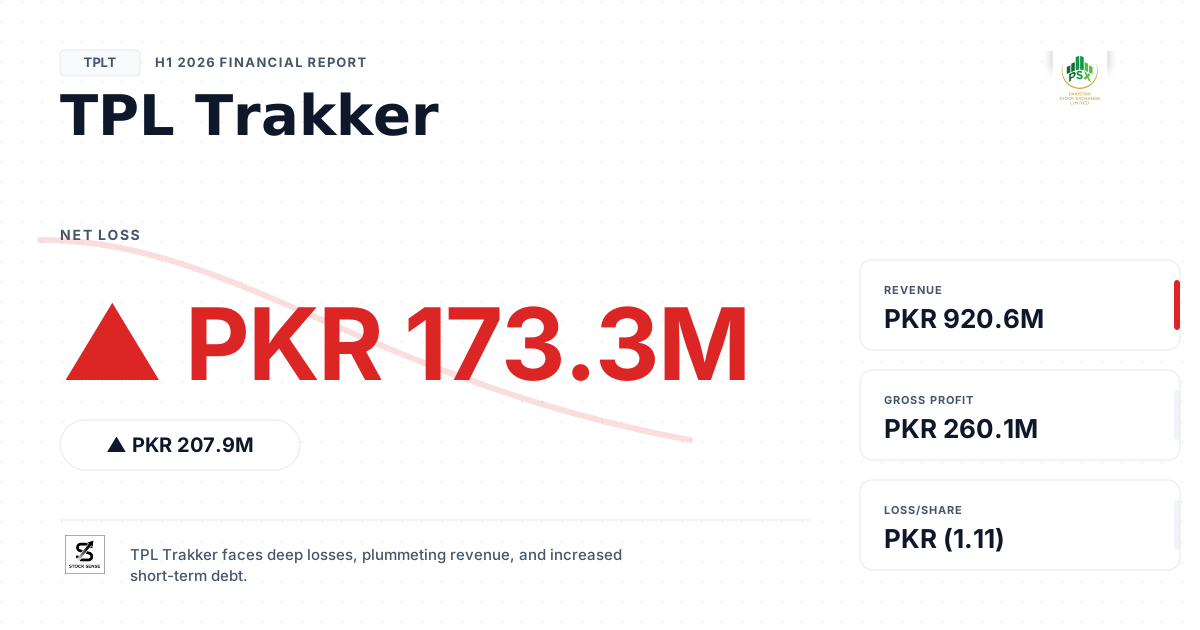
TPL Trakker Limited (TPLT) has reported a challenging first half for fiscal year 2026, marked by a significant decline in revenue and a substantial increase in net losses. The company's latest financial results for the six months ended December 31, 2025, reveal a concerning trend that demands close attention from investors, particularly given the absence of any shareholder payouts.
Financial Performance Overview
Consolidated turnover for the Half-Year ended December 31, 2025, experienced a sharp contraction of approximately 37.6%, falling to PKR 920.6 million from PKR 1,475.4 million in the corresponding period last year. This significant deceleration is a primary concern, potentially indicating market share erosion or reduced demand for TPLT's core services.
The revenue decline directly impacted profitability across the board. Gross profit plummeted from PKR 584.7 million to PKR 260.1 million, leading to a compression in gross margins from roughly 39.6% to 28.2%. Operating profit also saw a steep reduction, settling at PKR 68.4 million compared to PKR 157.5 million previously. The most striking figure is the net loss, which widened significantly to PKR 207.9 million for H1 2026, a stark contrast to the PKR 34.6 million loss reported in H1 2025. This translates to a loss per share of PKR (1.11), a substantial increase from PKR (0.13) in the prior year.
Operating cash flow, while remaining positive at PKR 43.6 million, saw a substantial reduction from PKR 282.8 million in H1 2025. The company continued its investment activities, utilizing PKR 28.0 million, and deployed PKR 42.1 million in financing activities. Cumulatively, this led to a net decrease of PKR 26.6 million in cash and cash equivalents during the period.
On the balance sheet, total assets remained relatively stable at PKR 5,767.7 million. However, total equity decreased from PKR 1,744.8 million to PKR 1,537.1 million, primarily due to the accumulated losses. Concurrently, current liabilities increased, and short-term borrowings rose from PKR 1.03 billion to PKR 1.13 billion, suggesting a greater reliance on short-term debt to manage liquidity.
Key Drivers and Unanswered Questions
The primary driver for this poor performance is the substantial reduction in turnover, signaling a significant slowdown in the company's core business activities. While the cost of sales and services decreased, its reduction did not keep pace with the revenue drop, directly contributing to the observed gross margin compression.
Finance costs, though lower than the previous year at PKR 149.7 million (down from PKR 212.8 million), remain a substantial burden, continuing to weigh heavily on the bottom line. A notable challenge for investors is the absence of a breakdown of performance by specific business segments within the financial statements, making it difficult to pinpoint which areas contributed most significantly to the revenue decline.
Management's Strategic Signals
The Board of Directors explicitly recommended "Nil" for cash dividends, right shares, bonus shares, or any other entitlement. This decision clearly signals a focus on preserving capital amidst the mounting losses. The company also significantly scaled back its capital expenditure, with net additions to property and equipment falling from PKR 24.5 million to PKR 6.0 million, and intangible asset additions decreasing from PKR 54.9 million to PKR 31.3 million. This indicates a cautious approach to expansion or a direct response to the challenging financial environment. The increase in short-term borrowings further suggests the company is actively managing its liquidity, likely for working capital needs. The official announcement provides no forward-looking statements or guidance on future performance, leaving investors to infer the outlook solely from the current results.
Investor Takeaway: Navigating the Headwinds
TPLT's latest results paint a concerning picture for investors, highlighting significant operational and financial challenges. The sharp decline in revenue and the widening net loss are critical issues that demand immediate attention. Investors should closely monitor any future announcements regarding management's strategies to revive revenue growth, improve operational efficiencies, and effectively manage the persistent burden of finance costs. Any signs of market recovery or new initiatives in its core Trakker business or other segments will be crucial for a potential turnaround.
The key risks for TPLT include continued revenue contraction, further erosion of profitability, and the sustained impact of high finance costs. The absence of dividends means the investment thesis must rely entirely on a future turnaround and capital appreciation. Given the current performance, a rational investor would seek clear communication on management's plans to navigate these headwinds and restore the company to a path of sustainable growth and profitability.